
Chapter 9 · The basics · 5 min read
Accounting Basics
On this page
SAABI keeps your books using double-entry bookkeeping. You do not need to understand it to raise an invoice or record a payment — SAABI writes the entries for you. You do need it to read the reports, to judge whether a figure looks right, and to post a journal entry by hand. This chapter is a short primer on the ideas the rest of the manual assumes.
A small business in four transactions
Imagine you are starting a home interior business. Four things happen in the first month.
Owner investment. You put $500,000 of your own money into the business.
Note
The bank balance is now $500,000.
First expense. You rent a co-working space where you can work and meet clients, at $40,000 per month. This is your first expense.
Note
The bank balance is now $500,000 − $40,000 = $460,000.
First income. You make your first sale, worth $30,000, and the customer pays at once. This is your first income.
Note
The bank balance is now $460,000 + $30,000 = $490,000.
Amount payable. You hire a web agency to build a website. They charge $50,000, payable in two months. No money has moved, but you are liable to pay it, so it is recorded under Accounts Payable.
Events and accounts
Listing the four events and their effect:
| # | Event | Amount |
|---|---|---|
| 1 | Owner Investment | + $500,000 |
| 2 | Rent | − $40,000 |
| 3 | Sales | + $30,000 |
| 4 | Accounts Payable | − $50,000 |
| 5 | Total | $440,000 |
That $440,000 total is what the business is worth to you after the four events.
The same four events, sorted into the five types of account, with the balance each one carries:
| # | Account | Amount |
|---|---|---|
| 1 | Asset (Bank) | $490,000 |
| 2 | Liability (Accounts Payable) | $50,000 |
| 3 | Equity (Owner's Capital) | $500,000 |
| 4 | Income (Sales) | $30,000 |
| 5 | Expense (Rent) | $40,000 |
| 6 | Expense (Website) | $50,000 |
The website charge is an expense in the month the work was done, even though the cash has not left the bank yet: the expense and the liability are recorded together.
The accounting equation
Everything a business owns was funded either by someone it owes money to, or by its owners. That gives the accounting equation:
Assets = Liabilities + Equity
Income and expenses are the two things that change equity during a period, so the fuller form is:
Assets = Liabilities + Equity + Income − Expenses
Check it against the figures above: assets of $490,000 equal liabilities of $50,000 plus opening capital of $500,000, plus income of $30,000, less expenses of $90,000. The closing equity of $440,000 matches the total in the first table.
Every transaction is recorded in two accounts, one debit and one credit of the same amount, so the two sides can never drift apart. When they do, the Trial Balance report shows it.
How each transaction affects two accounts
1. Owner investment. The money in the bank, an asset, increases by $500,000. The owner's claim on the business, an equity account, increases by the same amount.
| Account | Credit | Debit |
|---|---|---|
| Owner's Equity | $500,000 | 0 |
| Bank Account | 0 | $500,000 |
2. Rent. Rent is an immediate expense, recorded in the Rent account. The money is spent from the bank account, so that asset decreases by $40,000.
| Account | Credit | Debit |
|---|---|---|
| Rent Account | 0 | $40,000 |
| Bank Account | $40,000 | 0 |
3. First sale. The sale is recorded in the Sales account, an income account, which increases by $30,000. The payment arrives in the bank account, which increases by as much.
| Account | Credit | Debit |
|---|---|---|
| Income Account | $30,000 | 0 |
| Bank Account | 0 | $30,000 |
4. Hiring the web agency. You are liable to pay in future, so Accounts Payable increases by $50,000. The work is an expense, so the expense account increases by $50,000 as well.
| Account | Credit | Debit |
|---|---|---|
| Accounts Payable | $50,000 | 0 |
| Expense Account | 0 | $50,000 |
Every transaction touches two accounts. To see this in your own books, submit a sales invoice, then open General Ledger and look at the rows carrying that invoice number: one debit and one credit for every amount on the invoice.
Credit and debit
Credit and debit mean opposite things depending on the account they are applied to.
- For asset and expense accounts, a debit increases the balance and a credit decreases it.
- For liability, equity and income accounts, a credit increases the balance and a debit decreases it.
Tip
Remember it as AEDLIC: Assets and Expenses Debit, Liabilities and Income Credit.
The five account types in SAABI
Every account in your chart of accounts belongs to one of five types, and each type sits under one of SAABI's five root groups. Open Setup > Chart of Accounts to see them.
| Account type | What it records | Increases with | SAABI root group |
|---|---|---|---|
| Asset | What the business owns or is owed | Debit | Application of Funds (Assets) |
| Liability | What the business owes to others | Credit | Source of Funds (Liabilities) |
| Equity | The owners' claim on the business | Credit | Equity |
| Income | Revenue earned in the period | Credit | Income |
| Expense | Costs incurred in the period | Debit | Expenses |
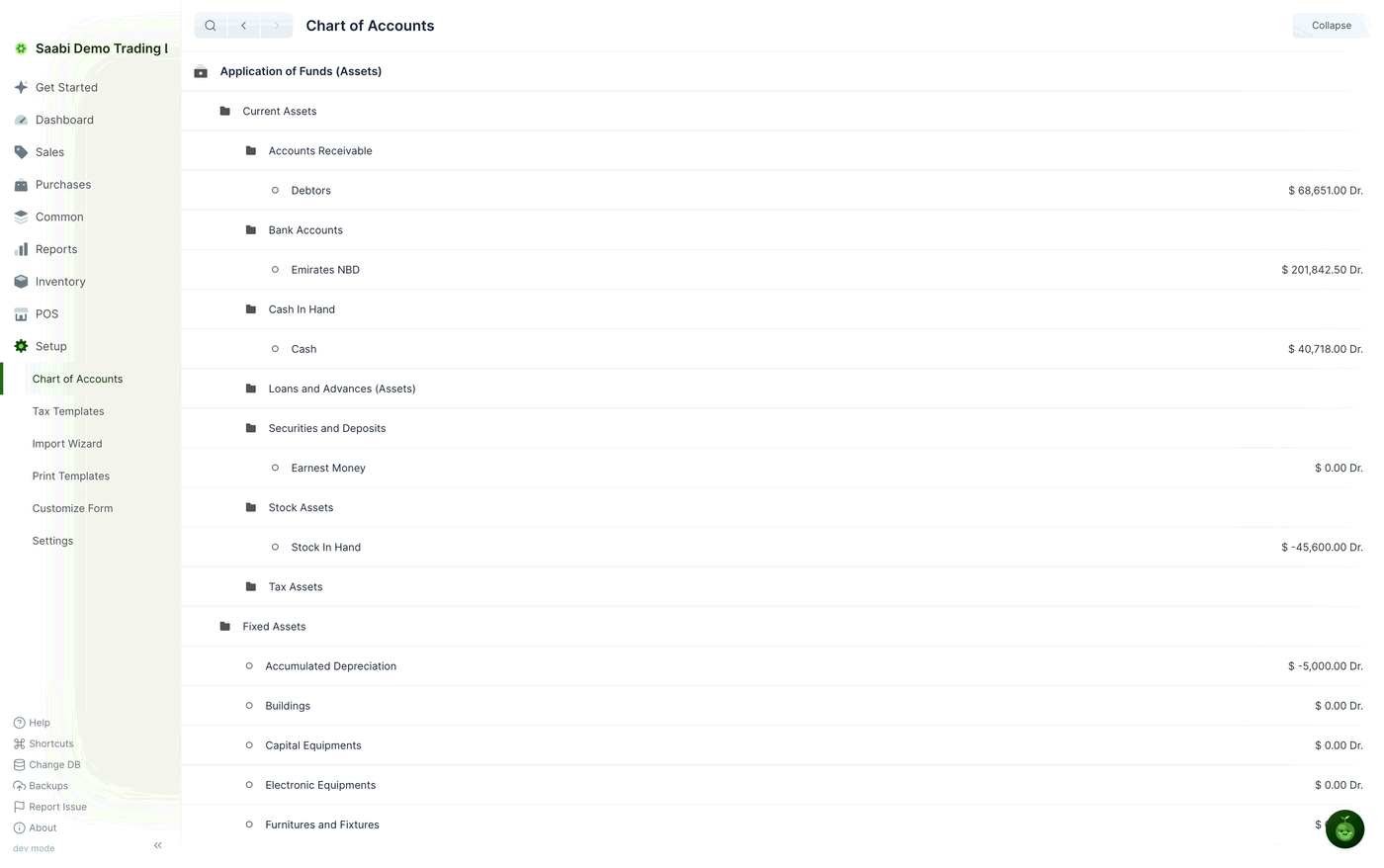
Accounts come in two kinds. Ledger accounts are the ones transactions are posted to. Group accounts hold other accounts and carry no entries of their own — their balance is the sum of what sits beneath them. The five root groups are group accounts.
Important
A root group is either a debit group or a credit group, and every account beneath it follows suit. This is why a bank account shows its balance as Dr. and a supplier account as Cr. in the Chart of Accounts.
Assets, liabilities and equity are balances at a point in time, and are what the Balance Sheet reports. Income and expenses accumulate over a period and reset at the year end, and are what the Profit and Loss report covers.
Saabi Desktop User Manual 1.0 · covers Desktop 1.0.0 · Something wrong or missing? Tell us